Blind Rivets: Efficient Fasteners for Single-Sided Riveting
Blind Rivets: Practical Fasteners Solving Construction Challenges
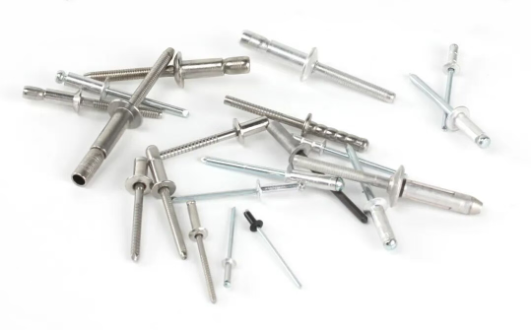
In the field of fastener technology, blind rivets are high-performance single-sided riveting products. Their core technical advantage lies in "no need for double-sided operation", which can effectively overcome the connection difficulties caused by inconvenient construction on the reverse side of components.
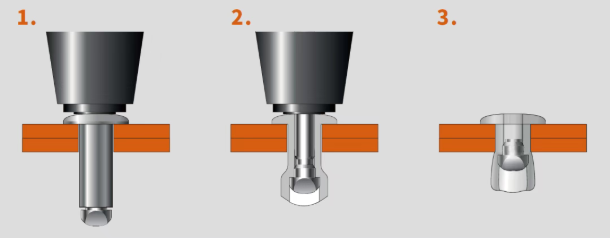
Compared with traditional rivets, operation only requires pulling the mandrel with special tools to promote the expansion and deformation of the rivet body, thereby achieving a firm connection of components. This significantly improves riveting efficiency, especially suitable for installation operations in special working conditions such as closed structures and narrow spaces.
Material Classification of Blind Rivets: Performance Selection for Different Scenarios
Material selection is a key link in blind rivet selection, directly determining their applicable scenarios and performance.
- Aluminum alloy: The most widely used material, combining lightweight characteristics and good corrosion resistance, suitable for fields sensitive to component weight.
- Carbon steel: Core advantage is high strength with stronger load-bearing capacity, widely used in mechanical parts, heavy equipment and other scenarios with high load-bearing requirements.
-
Stainless steel: Possesses both excellent corrosion resistance and structural strength. Even in outdoor humid environments or acid-base medium working conditions, it can maintain stable performance, making it more suitable for harsh environments such as outdoor facilities and chemical equipment.
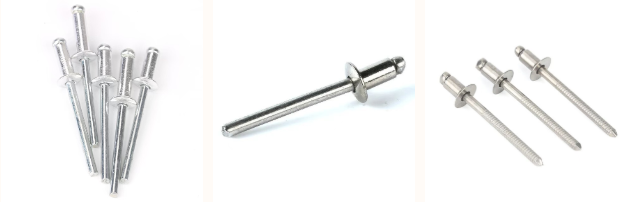
Aluminum Alloy Carbon Steel Stainless Steel
Common Types and National Standards of Blind Rivets: Differences from Basic to Sealed Types
Common standard blind rivets mainly include the following types, which can be selected according to actual application needs:
-
Open-end Round Head Blind Rivets (GB/T 12618): As a general-purpose product in basic models, its head adopts a rounded arc design without sharp edges and corners, combining aesthetics and practicality. This type of rivet has stable mandrel breaking force, ensuring firm connection even for riveting thinner plates. It also has significant cost advantages, suitable for basic connection scenarios such as electrical chassis cabinet assembly and aluminum alloy/stainless steel door and window manufacturing.
-
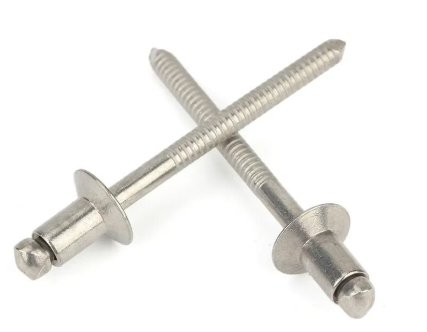
Open-end Countersunk Head Blind Rivets (GB/T 12617): Specifically designed for the demand of "flat component surface", with a countersunk head structure. By pre-setting a countersink in the component, the head can be flush with the component surface after riveting, avoiding protruding structures affecting subsequent assembly processes while ensuring appearance integrity. Suitable for scenarios such as instrument casings (ensuring panel fit without interfering with operation), automotive interior panels (preventing fabric scratches), and furniture drawer slides (avoiding clothing damage).
-
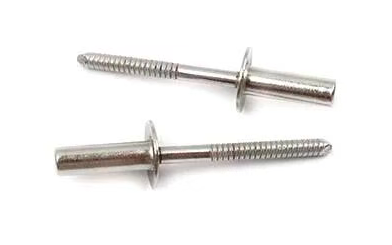
Closed-end Round Head Blind Rivets (GB/T 12615): Core performance focuses on sealing protection. The tail of the rivet body is a closed structure, and a sealed cavity can be formed after the mandrel is broken, effectively blocking the intrusion of moisture, dust, oil and other impurities. Suitable for scenarios requiring sealing performance such as outdoor lamps (preventing short circuits caused by rainwater), automotive chassis pipelines (resisting contamination by sludge and sand), and aquarium frames (blocking water vapor penetration).
In addition to the above common types, there are also special blind rivets adapted to special working conditions:
-
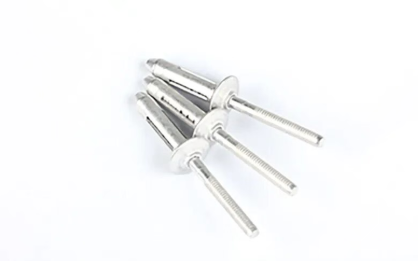
Lantern Rivets: Named for their lantern-shaped rivet cap after riveting. Their unique three-legged support structure can achieve uniform pressure distribution, suitable for fragile or flexible materials such as glass, plastic and rubber, effectively avoiding cracks or deformation of materials during riveting.
-
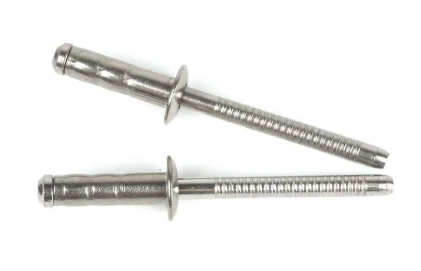
Double-Drum Blind Rivets: Increase the contact area with the riveted parts through the double-drum structure, which can disperse riveting pressure more evenly, thereby improving tensile and shear strength and ensuring connection stability. Suitable for riveting operations of lightweight structural parts.
-
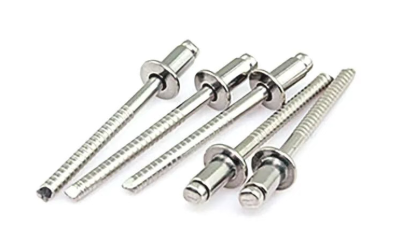
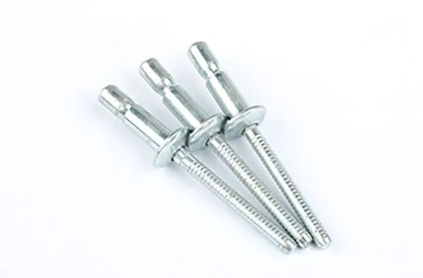
Cup-Type Threaded Rivets: Composed of two parts: rivet body and mandrel. The mandrel head adopts a cup-type design with free contraction deformation capacity. The rivet body is pre-provided with grooves. When the mandrel is pulled into the rivet body, the broken nail can be flanged and embedded into the grooves, significantly improving riveting strength.
-
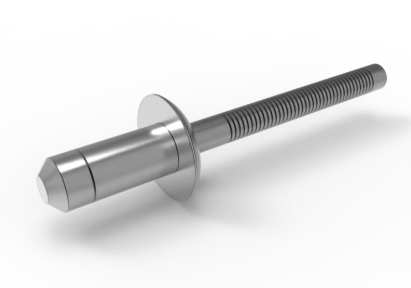
Seahorse Blind Rivets: After riveting, the rivet sleeve expands into a seahorse abdomen shape, which can closely fill the gap between the connected parts to form a firm mechanical interlocking structure. It has excellent tensile, shear performance, seismic and impact resistance.
Multi-Industry Applications of Blind Rivets: Covering Automotive, Construction, Electronics and Other Fields
Relying on diverse performance advantages, blind rivets are widely used in various industry scenarios:
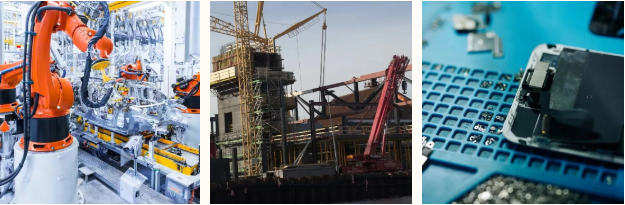
- Automotive industry: Aluminum alloy or stainless steel products are selected to connect automotive body accessories and chassis, balancing lightweight requirements with vibration and corrosion resistance.
- Construction field: Carbon steel or stainless steel products are used to install curtain walls and steel structures, ensuring the safety and efficiency of high-altitude operations.
- Electronics industry: Small aluminum alloy products are used to connect household appliances and communication equipment, adapting to precision installation needs.
-
Outdoor guardrails, billboards, lamps and other scenarios: Closed-type products are preferred to extend the service life of components through sealing performance.
Professional Fastener Solutions
As a professional fastener solution service provider, IIIBEAR offers professional support for your blind rivet selection needs. Whether you focus on material adaptability, national standard compliance, or need to match specific application scenarios:
- Visit our website: www.iiibearfastener.com
Our technical team will provide you with professional selection guidance and efficient procurement support.
Related products: Rivets

