T-Nut: Core Fastener in Industrial Assembly
T-Nut: Core Fastener in Industrial Assembly
With the development of industrial technology, connection technology plays an increasingly important role in industrial production. As an efficient and stable fastener, T-nut is widely used in industrial automation equipment, construction structures, photovoltaic supports and other fields due to its unique design and diverse application scenarios.
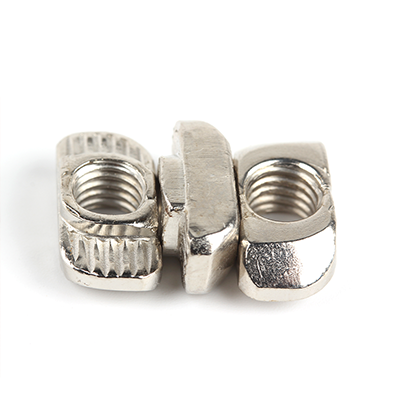
Design Features and Advantages of T-Nut
Named after its simple "T" shape, T-nut is a type of rear-mounted nut. The so-called "rear-mounted" means that it can be directly inserted into the groove of the profile after the profile frame has been assembled, and secondary installation or adjustment can be completed. Compared with traditional nuts, T-nut has the following significant features:
- Convenient Installation: T-nut can be installed without disassembling the frame, especially suitable for the expansion and adjustment of complex structures. It perfectly matches the standardized profile groove design, allowing for quick installation and adjustment, which greatly improves assembly efficiency.
- Automatic Positioning: In the profile groove, T-nut can achieve precise automatic positioning through its shape, ensuring the accuracy of the assembly position.
- Stable and Reliable: T-nut has a self-locking function, which can effectively prevent loosening caused by vibration or external force, improving the safety and stability of the connection.
- Strong Adaptability: Suitable for profile frames of different materials and specifications, meeting diverse connection needs.
Materials and Specifications of T-Nut
T-nuts can be divided into the following categories according to different materials, each with its specific application scenarios and performance characteristics:
1. Stainless Steel T-Nut
Features: Strong corrosion resistance, high strength, and able to adapt to humid and corrosive environments.
Application: Suitable for outdoor installations, photovoltaic supports, marine environments, etc.
2. Carbon Steel Nickel-Plated T-Nut
Features: Low price, certain anti-corrosion performance, suitable for indoor use.
Application: Common industrial equipment, furniture manufacturing, etc.
3. Aluminum Alloy T-Nut
Features: Light weight, corrosion resistance, suitable for assembly requirements sensitive to weight.
Application: Light industrial equipment, aerospace field, etc.
In terms of specifications, T-nuts are usually divided into 20 series, 30 series, 40 series, and 45 series according to the groove width of the profile. Different specifications are suitable for different profile frames. For example:
- 20 series is suitable for small structures of light frames.
- 40 series and 45 series are suitable for industrial frames承受较高负载 (with higher load-bearing capacity).
Users can choose suitable materials and specifications according to the actual application scenario to ensure the stability and durability of the assembly.
Standard Classification of T-Nut
According to different application standards, T-nuts are mainly divided into two categories: European standard and Chinese national standard.
1. European Standard T-Nut
European standard T-nuts are suitable for aluminum profiles that meet European standards, and the materials generally include two categories: stainless steel and nickel-plated steel.
① Stainless Steel European Standard T-Nut
- 30 series: Common specifications are M5, M6, suitable for small to medium frames, usually matched with 12mm long stainless steel bolts, with good corrosion resistance.
- 40 series: Including M5, M6 specifications, suitable for medium frames, it is recommended to match with 16mm long stainless steel bolts to improve bearing capacity.
- 45 series: M6, M8 specifications are suitable for heavy frames, with stronger tensile strength and corrosion resistance.
② Nickel-Plated Steel European Standard T-Nut
- 20 series: M4, M5, suitable for small frame assembly, cost-effective.
- 30 series: M4, M5, M6, suitable for medium frames, meeting most application needs.
- 40 series: M4, M5, M6, M8 (Note: M8 is not suitable for 4040A light aluminum profiles), suitable for larger frames, providing high-strength connections.
- 45 series: M4 to M8 specifications are available, suitable for structures with high-strength requirements.
2. Chinese National Standard T-Nut
Chinese national standard T-nuts are suitable for aluminum profiles that meet China's domestic standards, and usually use carbon steel nickel-plated materials, meeting general industrial assembly needs with outstanding cost performance.
- ① 30 series: Common specifications are M4, M5, suitable for national standard groove 6 series profiles, suitable for light structure assembly.
- ② 40 series: M5, M6 specifications are suitable for national standard groove 8 series profiles, which can meet the connection needs of medium loads.
European standard and Chinese national standard T-nuts have their own characteristics in terms of materials, adapted profiles, specifications, etc. Users should choose suitable T-nuts according to actual load requirements, usage environment, and frame standards to ensure the stability and reliability of the assembly.
T-nut has become an important part of modern industrial assembly with its efficient and stable characteristics. From industrial automation equipment to construction structures, from photovoltaic new energy to furniture manufacturing, T-nut plays a key role in a variety of fields. With the continuous innovation of technology, its application scenarios will be more extensive, bringing more possibilities to industrial production. If you are looking for an efficient and flexible connection solution, T-nut is undoubtedly a trustworthy choice.
Related products: Nuts

