Understanding the Unified Thread Standard for UNC and UNF Fasteners
Understanding the Unified Thread Standard for UNC and UNF Fasteners
unified thread standard is the core technical framework behind American fastener engineering. It uses an inch-based measurement system and a 60° thread profile, forming a complete structure that includes UNC, UNF, UNEF, UN/UNR fixed-pitch series, and UNS special threads. This system is widely applied in machinery, construction, automotive components, energy equipment, and other heavy-duty industrial fields.
As a trusted manufacturer, IIIBEAR provides American-standard bolts, nuts, studs, and precision components that follow recognized dimensional, mechanical, and thread tolerance requirements.
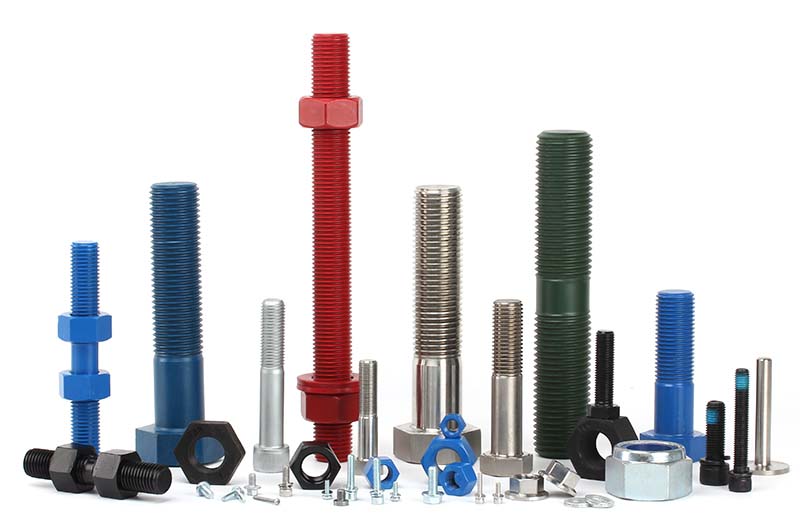
What UNC Threads Are Designed For
UNC (Unified National Coarse) threads use a coarse pitch, which provides better resistance to stripping, smoother assembly, and higher durability in softer materials. Their wider thread spacing allows quick engagement and stable performance, making them the most common specification in general engineering and mass-production fasteners.
Industries often search phrases such as “UNC thread chart,” “UNC bolt sizes,” and “coarse thread applications,” demonstrating strong demand for UNC specifications in global sourcing and maintenance tasks.
Why UNF Threads Provide Higher Strength
UNF (Unified National Fine) threads have finer pitch and a larger minor diameter, resulting in greater tensile stress area and improved resistance to vibration. Because of their smaller lead angle, UNF threads allow more precise adjustments, making them ideal for automotive, aerospace, hydraulic systems, and high-strength industrial components.
The combination of higher load capacity and better fatigue performance makes UNF a preferred choice when engineers require compact but robust fastening solutions.
Enhanced Fatigue Performance of UNR Thread Roots
UNR threads incorporate a mandatory rounded root radius, significantly improving fatigue life under cyclic loading. This characteristic is especially important for critical structural bolts and socket head cap screws. The rounded root reduces stress concentration and enables higher reliability during long-term operation.
Because of this design advantage, engineers often search for “UNR thread fatigue strength,” “UNR vs UN comparison,” and “rounded root thread performance,” indicating the growing popularity of this thread series in demanding applications.
Understanding 1A/2A/3A and 1B/2B/3B Thread Classes
American threads follow a well-defined tolerance system. External threads use classes 1A, 2A, and 3A, while internal threads use 1B, 2B, and 3B. Class 2A/2B is the most widely used combination for commercial fasteners due to its balanced clearance, manufacturability, and ease of assembly.
Class 3A/3B, with tighter tolerances, is intended for high-precision assemblies requiring minimal play, often found in aerospace and instrument-grade components.
Why the Unified Thread System Remains Important
Although metric fasteners are prevalent globally, UNC and UNF systems remain essential in American-designed machinery, oil and gas facilities, steel structures, and transportation equipment. Selecting the correct thread system is critical to ensuring compatibility, avoiding cross-threading failures, and maintaining mechanical performance.
With decades of evolution, unified threads offer a comprehensive and reliable platform for industrial fastening. For buyers and engineers working across regions, understanding UNC, UNF, and UNR threads is necessary for selecting accurate replacements and ensuring long-term structural integrity.