Do You Know Circlips (Retaining Rings)?
Do You Know Circlips (Retaining Rings)?
Retaining rings, a type of annular component used for fixing or positioning parts, possess elasticity—hence they are also known as elastic retaining rings (also called circlips or snap rings). They are usually precisely installed in pre-designed grooves on shafts or holes. Despite their small size, they utilize their unique elastic structure to prevent axial movement or accidental detachment of key components such as bearings and gears in a simple and efficient manner. Gaining a deep understanding of the working principle of retaining rings and mastering the correct selection method are essential courses for improving assembly reliability and extending equipment service life.
I. Core Functions of Retaining Rings: The "Safety Valve" for Axial Positioning
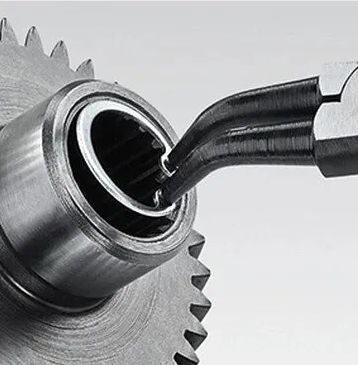
The core mission of retaining rings is to provide reliable axial positioning constraints. They are precisely installed in grooves on shafts (shaft-mounted retaining rings) or grooves inside holes (hole-mounted retaining rings). By leveraging their own elastic deformation and the geometric constraints of the grooves, they form a rigid mechanical stop surface.
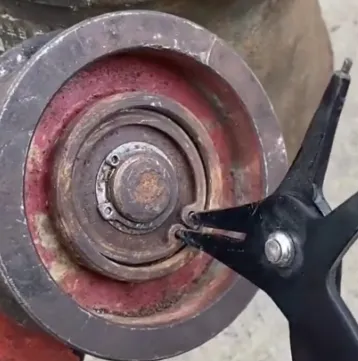
Its core values are specifically reflected in the following aspects:
- ① Prevent axial displacement of components: Ensure that rotating or stationary components such as bearings, gears, and gaskets always remain in their designed axial positions, avoiding displacement caused by vibration or load changes.
- ② Simplify assembly and disassembly: Installation can usually be completed with a simple circlip plier, without the need for complex tools or thread fastening, improving maintenance efficiency by more than 50%.
-
③ Save space and cost: With an extremely compact structure, it is suitable for design scenarios with limited space; compared with other axial fixing methods (such as nuts and end caps), the cost can be significantly reduced by 30%.
II. The Retaining Ring Family
Retaining rings are mainly divided into two categories—shaft-mounted retaining rings and hole-mounted retaining rings—based on their installation positions. They comply with international standard systems to ensure interchangeability, universality, and reliability:
01 Shaft-Mounted Retaining Rings (External Circlips)
GB/T 894-2017 Standard: Covers standard type (Type A) with a bore diameter range of 3mm to 300mm, and heavy-duty type (Type B) suitable for higher loads with a bore diameter range of 15mm to 100mm.
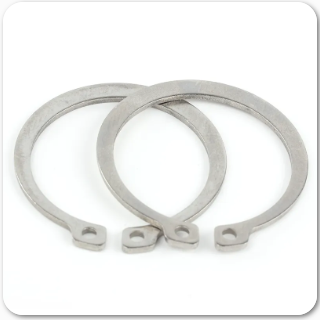
02 DIN 471 Shaft-Mounted Circlips
German Industrial Standard, D1400 series, widely used for fixing the shaft ends of bearings and gears.
03 Hole-Mounted Retaining Rings (Internal Circlips)
GB/T 893-2017 Standard: Covers standard type (Type A) with a bore diameter range of 8mm to 300mm, and heavy-duty type (Type B) with a bore diameter range of 20mm to 100mm.
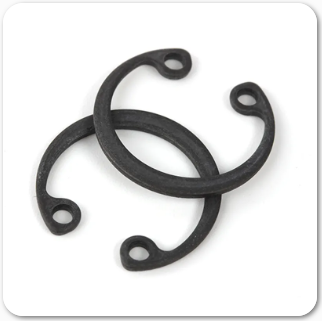
04 DIN 472 Hole-Mounted Circlips
German Industrial Standard, D1300 series, specially designed for installation in grooves inside holes to provide stable and uniform axial binding force.
In addition, the following retaining rings are also available based on structural forms and application scenarios:
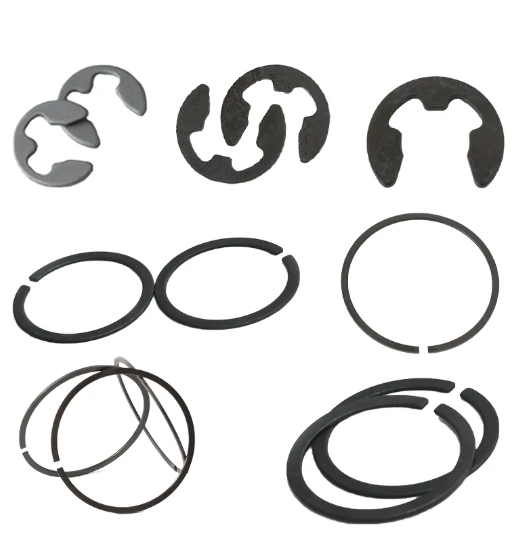
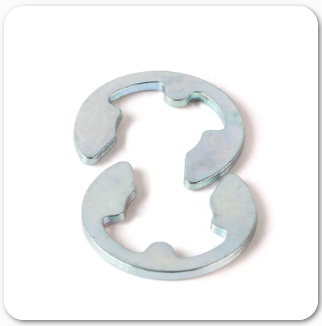
01 Split Retaining Rings
Also known as E-rings, they have an opening and are snapped into the groove using elasticity, enabling convenient installation. They are suitable for general equipment and regular load environments, and are the most widely used type.
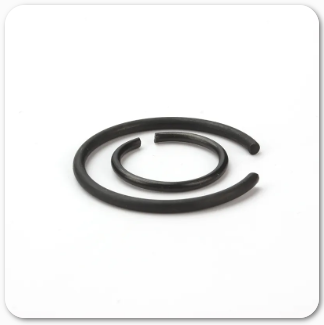
02 Wire Retaining Rings
Open annular (C-shaped rings) with uniform force bearing and excellent shear resistance. The groove design can disperse stress and reduce the risk of damage. Made of wire, they have good elasticity and can deform to a certain extent without breaking.
III. Inspection Process & Quality Control: Ensuring Usage Reliability
Taking IIIBEAR—which has obtained IATF16949 automotive industry quality certification—as an example, the production of retaining rings implements a strict three-level quality control system:
1. Dimensional and Appearance Inspection
Inspect key dimensions such as inner diameter, outer diameter, and thickness. For large-sized retaining rings, 100% visual inspection is conducted to eliminate products with surface defects such as cracks, burrs, and rust.
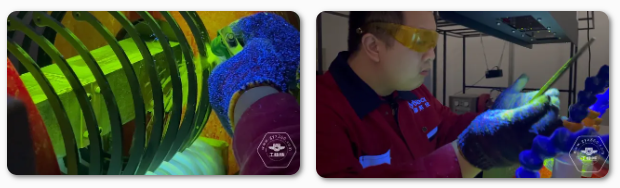
2. Fluorescent Magnetic Particle Non-Destructive Testing
Adopt non-destructive testing methods such as magnetic particle testing (MT) to check for potential defects such as internal microcracks.
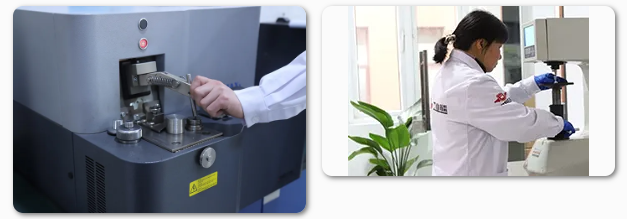
3. Material Performance Verification
Conduct spectral analysis to ensure that the chemical composition of the material meets the standards. Perform hardness testing and tensile strength testing to verify that the mechanical properties comply with the standards.
4. Environmental Protection Inspection
For products with additional coatings, if environmental protection certificates are required, RoHS testing can be conducted to ensure that the products do not contain harmful substances such as lead, mercury, and cadmium, meeting environmental protection requirements.
IV. Cross-Industry Applications: The Great Mission of Small Components
Retaining rings are used in almost all industrial fields and are crucial for ensuring the stable operation of core components:

Automotive Manufacturing
Fixing of transmission bearings (DIN 471 retaining rings are commonly used), axial limiting of wheel hub units (GB/T 894 heavy-duty retaining rings are commonly used).
Precision Machinery
Fixing of machine tool spindle bearings (high-precision wire retaining rings are often selected), axial constraint of robot joints (retaining rings with lugs facilitate maintenance).
Energy Equipment
Fixing of wind power gearbox bearings (corrosion-resistant stainless steel retaining rings are required), limiting of hydraulic cylinder piston rods/cylinders (hole-mounted retaining rings).
Electronic and Electrical Appliances
Fixing of UAV motor shafts (micro shaft-mounted retaining rings), limiting of servo driver output shafts (precision hole-mounted retaining rings).
Related products: Retaining Rings

