All About Fastener Hardness Testing
【IIIBEAR Technical Q&A】All About Fastener Hardness Testing
Currently, three testing methods are used for the hardness of fasteners: Rockwell hardness, Brinell hardness, and Vickers hardness. Regarding the hardness testing methods for fasteners, the editor often encounters some questions from fans, such as:
How should the commonly used hardness tests—Brinell, Rockwell, and Vickers hardness tests—be selected?
Hardness testing methods generally follow three national standards: GB/T 230.1 Metallic Materials—Rockwell Hardness Test—Part 1: Test Method, GB/T 231.1 Metallic Materials—Brinell Hardness Test—Part 1: Test Method, and GB/T 4340.1 Metallic Materials—Vickers Hardness Test—Part 1: Test Method.
When conducting product hardness testing, it is necessary to know the product's hardness range according to the actual product technical requirements, and then refer to the hardness test standards to select the correct equipment, test indenter, and scale.
Strictly implementing the test specifications is an important process to ensure the accuracy of product quality testing data and promote effective quality control.
Next, the editor will give two examples of the practical application of hardness testing to help you more intuitively understand the importance of choosing the correct hardness testing method.
(1) Selecting the appropriate hardness test according to product characteristics
The JB/T 7590-2005 Technical Conditions for Steel Wave Springs for Motors specifies a process reference hardness of 45-52 HRC. If we choose to use the Rockwell hardness test method to measure the hardness value of the wave spring, the result will differ from the standard value. Why is that?
First, according to the requirements of the GB/T 230.1-2018 Metallic Materials—Rockwell Hardness Test—Part 1: Test Method standard, the Rockwell hardness test is directly related to the thickness of the sample.
The standard specifies that the D100 specification has a thickness of 0.6 mm. The wave spring is thin and has a wave shape, failing to meet the thickness requirements of the Rockwell hardness test. Using the Rockwell hardness test to measure it conflicts with the product's Rockwell hardness test standard.
Therefore, based on the characteristics of this wave spring product, we choose to measure its Vickers hardness value. Measuring Vickers hardness requires a sample preparation process, including cutting, grinding, polishing, and inlaying the sample first.
The test results are: 480HV/491HV/489HV/485HV. Then, according to the GB/T 33362-2016 Metallic Materials—Conversion of Hardness Values standard, the Rockwell hardness test results are converted to: 47.7HRC/48.4HRC/48.3HRC/48.0HRC, leading to the conclusion that the product hardness meets the requirement of 42-52HRC.
Therefore, in the process of hardness testing, it is necessary to specifically analyze the selection of hardness test types according to the actual situation of the product. When performing Vickers hardness testing, if encountering irregular or too small products, inlay sample preparation treatment is required.
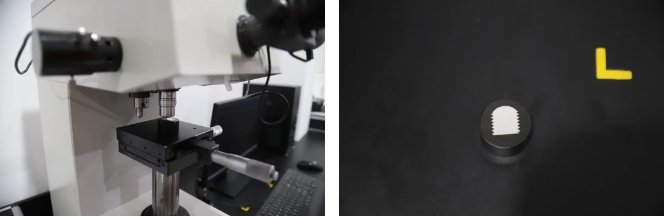
(2) Following the standards and preparing samples according to the sample standards
The editor takes the hardness test of a socket head cap screw as an example. Why does the measured hardness value still differ from the standard value even though we chose the Rockwell hardness testing method according to the product characteristics?
It turns out that due to the round spherical surface structure of this set screw and the processing of the hexagon socket with a punch, the support surface may be displaced or shaken. If we directly perform hardness testing on the surface, measurement results may be incorrect due to shaking, plating, etc.
- According to the GB/T 230.1-2018 Metallic Materials—Rockwell Hardness Test—Part 1: Test Method standard, before the Rockwell hardness test, the test piece should be prepared to obtain a suitable flat test surface.
-
The Rockwell hardness C scale has a pressure load of 150 kg, so the test process should be kept vertical to avoid shaking and displacement of the sample, which may cause deviations in the results.
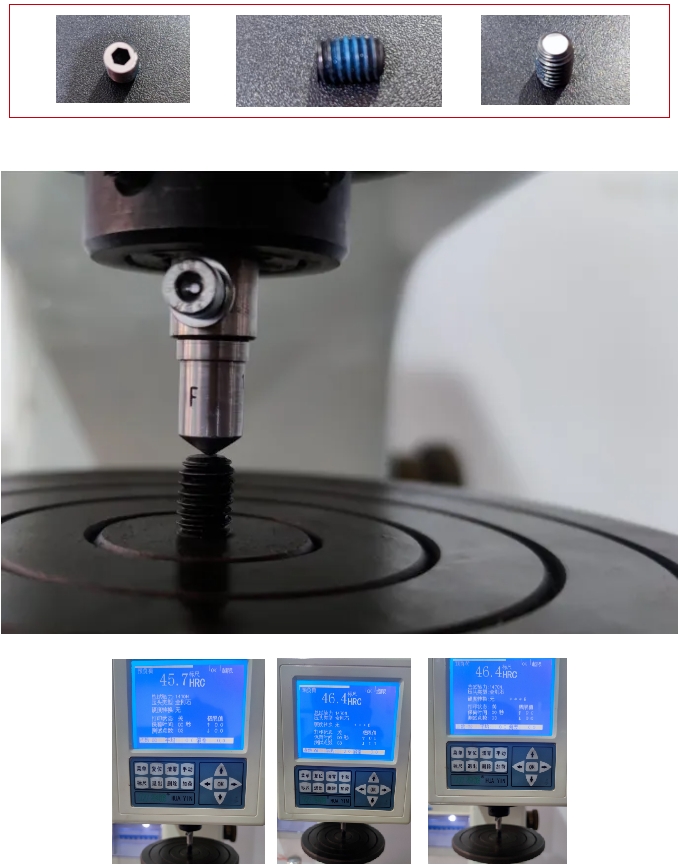
We need to sample a certain proportion as specified in the standard. According to the sample requirements, the set screw should be ground flat to remove the surface oxide layer to meet the hardness test requirements.
After the test, the measured samples are within the product's qualified range. The test results are: 45.7HRC/46.4HRC/46.4HRC, and the product hardness meets the quality parameter requirements.
Therefore, the hardness test of fasteners should follow the standard test methods, equipment specifications, test conditions, data processing, and report requirements, and select appropriate solutions according to product characteristics.
If you have fastener-related needs or questions about hardness testing, please contact the IIIBEAR website.
About IIIBEAR
IIIBEAR is committed to becoming a reliable and professional vertical e-commerce platform for fasteners, strictly implementing quality management systems such as IATF16949, ISO9001, PED/AD2000. Based on the nearly 20 years of R&D and production experience in fasteners of the Fubell Fastening System, the platform provides customers with accurate standard parts, non-standard parts, brand parts, technical selection, agile services, and intelligent logistics solutions through comprehensive quality management.
For more information, please visit our website and contact us.

