Hardness Testing and Tensile Strength Conversion | IIIBEAR
Introduction to Hardness Testing and Hardness-Tensile Strength Conversion Table
Introduction to Hardness
Hardness is one of the important performance indicators for measuring the softness and hardness of materials. There are many hardness testing methods with different principles, and the measured hardness values and meanings also vary. In terms of the hardness of steel, the code for metal hardness is H. According to different hardness test methods, conventional hardness indicators include Brinell hardness (HB), Rockwell hardness (HR), Vickers hardness (HV), etc.
Introduction to Different Hardness Tests
01 Brinell Hardness (HB)
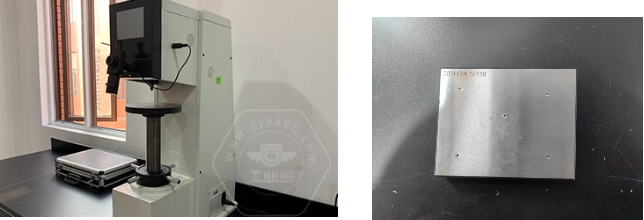
Brinell hardness is a test method that determines the hardness of a material by applying a certain pressure with an indenter on the surface of the sample and measuring the diameter of the indentation. Brinell hardness is mainly suitable for cast iron, non-ferrous alloys, various annealed and tempered steel parts, and also for the hardness determination of raw materials such as mild steel, hard steel, and thin plates. It is not suitable for measuring too hard, too small, too thin, and workpieces or samples whose surfaces do not allow large indentations.
The test method for Brinell hardness (HB) is: press a quenched steel ball or cemented carbide ball of a certain diameter into the surface of the tested metal under a certain load, maintain it for a period of time, then remove the load, measure the indentation diameter, and then calculate the Brinell hardness value based on the indentation diameter. The symbol is expressed as HBS or HBW.
The difference between HBS and HBW in Brinell hardness lies in the indenter. HBS uses a quenched steel ball as the indenter, which is suitable for measuring metal materials with a hardness value less than 450 HBS; HBW uses a cemented carbide ball as the indenter, which is suitable for measuring metal materials with a hardness value between 450-650 HBW.
With the use of international standards, my country has canceled the steel ball indenter and all adopted cemented carbide ball indenters. Cemented carbide ball indenters are generally used for Brinell hardness testing, so the use of HBS has gradually decreased, and HBW has become the main representation method of Brinell hardness.
In some literature and papers, the use of HBS may still be seen, which may be because these literatures were published earlier, or the authors are still accustomed to using the old hardness representation method. However, in modern material research and engineering applications, HBW has become a more common and standard Brinell hardness symbol, and generally, HB simply refers to HBW.
02 Vickers Hardness (HV)
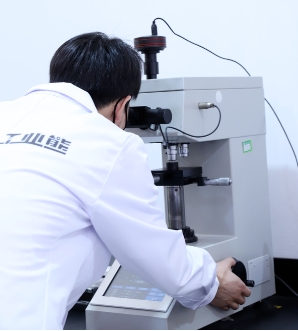
Vickers hardness is a test method that determines the hardness of a material by measuring the length of the diagonal, and the marking symbol is HV, where H represents hardness and V represents Vickers. Its measurement principle is similar to Brinell hardness. A diamond indenter with a square pyramid with a relative face angle of 136° is used to press into the surface of the material. After maintaining the specified time, the length of the indentation diagonal is measured, and then the hardness value is calculated according to the formula. The larger the hardness value, the harder the material.
Vickers hardness (HV) is suitable for the hardness determination of larger workpieces and deeper surface layers. Vickers hardness also includes small load Vickers hardness, with a test load of 1.961~<49.03N, which is suitable for the hardness determination of thinner workpieces, tool surfaces, or coatings; micro Vickers hardness, with a test load <1.961N, is suitable for the hardness determination of metal foils and extremely thin surface layers.
03 Rockwell Hardness (HR)

Rockwell hardness (HR) is an index that determines the hardness value based on the depth of plastic deformation of the indentation. According to the different hardness of the test material, it is expressed in three scales: HRA, HRB, and HRC, and their application ranges and characteristics are as follows:
- The use range of the HRA scale is 20-88 HRA, used for materials with higher hardness, such as thin steel plates and cemented carbides.
- The use range of the HRB scale is 20~100 HRB, used for materials with lower hardness, such as mild steel, non-ferrous metals, annealed steel, etc.
- The use range of the HRC scale is 20~70 HRC, with the widest application range, used for materials with higher hardness, such as quenched steel and cast iron.
Rockwell hardness testing is simple and fast, and can obtain accurate hardness values in a short time. It is widely used in manufacturing, quality control, material research, and other fields.
What is the Relationship Between Hardness Value and Tensile Strength?
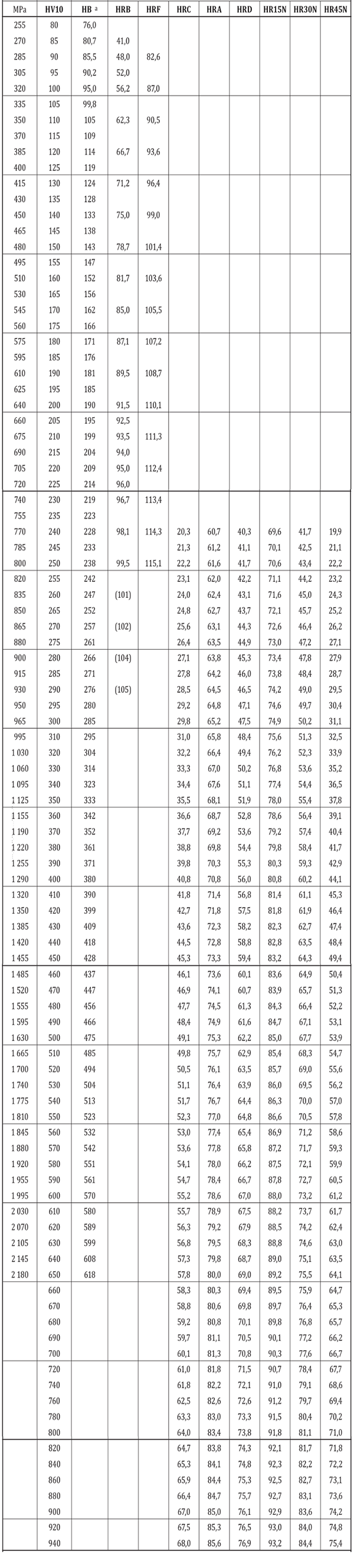
Hardness value and strength value are two important parameters for measuring the properties of metal materials. The strength value mainly reflects the ability of the material to resist plastic deformation, while the hardness value is determined by the initial plastic deformation resistance and the continuous plastic deformation resistance. Generally speaking, the higher the strength of the material, the higher its hardness value will be.
The advantage of hardness testing is that it is simple and easy to perform, does not damage the workpiece, and the test results are intuitive and easy to understand. This makes hardness testing one of the most important quality inspection indicators for heat-treated workpieces, and even the only technical requirement for many workpieces.
By using the hardness and strength conversion table, we can more easily understand the relationship between these two parameters, so as to more accurately evaluate the performance of materials in practical applications.
To learn more about fastener knowledge and industry solutions, please visit our website (IIIBEAR) and contact with us.