How to Measure Bolt Size: Diameter, Thread Pitch & Length | IIIBEAR
How to Measure Bolt Size: A Practical Guide to Diameter, Thread Pitch, Length, and Standards
how to measure bolt size is one of the most searched questions in fasteners because “bolt size” can mean different things depending on whether you use metric (ISO) or inch (UNC/UNF) standards. If you only measure the head across flats, you can still order the wrong bolt. To identify a bolt accurately for sourcing, replacement, or engineering drawings, you need four core dimensions: thread diameter, thread pitch (or TPI), bolt length, and thread type/standard.
This guide explains the exact steps, the tools you need (caliper, thread gauge, ruler), and common mistakes that cause mismatches. It also includes popular Google searches buyers use, such as “bolt size chart,” “thread pitch chart,” “metric bolt size chart,” and “UNC vs UNF,” so you can confirm your results and communicate clearly with suppliers.
What “Bolt Size” Really Means
In most product catalogs and RFQs, bolt size is expressed in a standard format:
- Metric bolts: M diameter × pitch × length (example: M10 × 1.5 × 50)
- Inch bolts: diameter – TPI × length (example: 3/8-16 × 2")
So when someone asks how to measure bolt size, the goal is to identify the diameter and the thread pitch (or TPI) first, then confirm the length and standard.
Tools You Need to Measure Bolt Size Accurately
- Digital caliper: for measuring thread diameter and head dimensions
- Thread pitch gauge: for measuring pitch (metric) or TPI (inch)
- Ruler or tape: for measuring bolt length
- Nut of known size (optional): for quick verification
If you do not have a thread pitch gauge, you can still measure pitch by counting thread peaks over a known distance, but a gauge is faster and more reliable.
Step 1: Measure the Thread Diameter (Major Diameter)
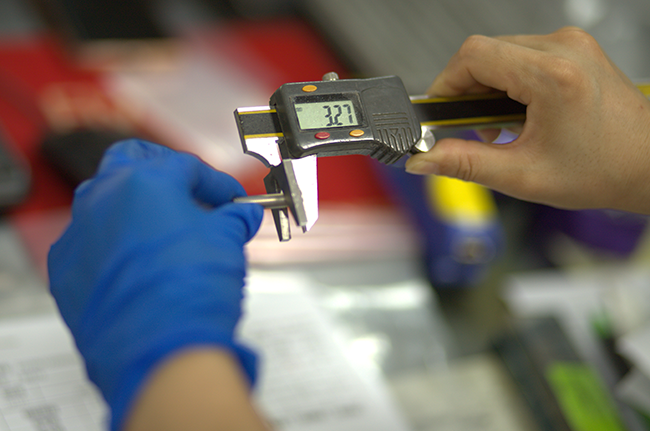
The thread diameter is measured across the outside of the threads (major diameter). Use a caliper and measure at the widest point across opposite thread crests.
- Metric example: if you measure about 10.0 mm, you are likely looking at an M10 bolt.
- Inch example: if you measure about 0.375" (9.53 mm), you are likely looking at a 3/8" bolt.
Common mistake: measuring the shank of a partially threaded bolt in a worn area or measuring a dirty or coated surface. Clean the bolt and measure the threaded section for best accuracy.
Step 2: Measure Thread Pitch (Metric) or Threads Per Inch (Inch)
This is where most people get stuck. Thread pitch is the distance between thread peaks, measured in millimeters for metric threads. Threads per inch (TPI) is the number of threads in one inch for inch-series bolts.
Best method: use a thread pitch gauge. Match the blade that fits perfectly into the threads without gaps.
Alternative method:
- Metric pitch: count 10 thread peaks and measure the distance in mm, then divide by 10.
- Inch TPI: measure a 1-inch segment and count the thread peaks.
Popular searches like “thread pitch chart” and “bolt size chart” are helpful at this step, because you can compare your measured pitch/TPI to standard options (for example M10 commonly uses 1.5 mm pitch, while 3/8" commonly uses 16 TPI for UNC).
Step 3: Measure Bolt Length the Correct Way
Bolt length is measured differently depending on head type. This is a frequent cause of wrong orders, especially for socket head or countersunk screws.
- Hex head bolts and most bolts with a flat bearing surface: measure from under the head to the end of the bolt.
- Countersunk (flat head): measure overall length, including the head, because the head sits flush in the joint.
- Socket head cap screws: generally measured from under the head (similar to hex bolts).
If you see confusion online, you are not alone—many buyers search “how to measure bolt length” specifically because head styles change the reference point.
Step 4: Identify the Thread Standard (Metric vs UNC/UNF vs Special Threads)
Once you have diameter and pitch/TPI, identify the standard. In most cases you are choosing between:
- Metric ISO: labeled with “M” sizes (M6, M8, M10, etc.)
- Unified threads: UNC (coarse) and UNF (fine), common in the US
Searches like “UNC vs UNF” are common because both can share the same diameter but different TPI. For example, 1/4-20 (UNC) and 1/4-28 (UNF) look similar but are not interchangeable.
Tip: If a nut threads on smoothly by hand for several turns, it is a good sign; if it binds early, you likely have a pitch mismatch.
How to Measure Bolt Size for Ordering: The Supplier Checklist
To order the correct fastener (or send an RFQ), confirm these details:
- Diameter: M10 or 3/8"
- Pitch/TPI: 1.5 mm or 16 TPI
- Length: 50 mm or 2"
- Head style: hex head, socket head, button head, countersunk
- Thread length: full thread or partial thread
- Material and finish: stainless 304/316, alloy steel, zinc plated, black oxide, etc.
These are the same attributes users search when they type “metric bolt size chart” or “bolt size chart,” because charts usually assume a standard head and do not capture material or finish requirements.
Common Mistakes When Measuring Bolts (And How to Avoid Them)
- Confusing head size with bolt diameter: head across flats is not the bolt size.
- Mixing metric and inch: M10 is close to 3/8" but not the same; pitches also differ.
- Ignoring coatings: thick coatings can slightly change measured diameter and thread fit.
- Measuring the wrong length reference: countersunk screws are measured overall length.
Need Help Identifying a Bolt? Work With an Experienced Fastener Supplier
When you need accurate identification for production or maintenance, the fastest path is to provide clear measurements and photos of the head and threads. At IIIBEAR, we support customers with bolt identification, standard matching (ISO/UNC/UNF), and sourcing for bolts, screws, nuts, washers, and threaded rods. If you share your diameter, pitch/TPI, length, and head type, we can quickly confirm the correct specification and recommend material and coating options for your environment.
Conclusion
How to measure bolt size correctly comes down to four steps: measure major diameter, measure thread pitch (or TPI), measure length based on head style, and confirm the thread standard. With a caliper and a thread gauge, you can avoid the most common ordering mistakes and match the right bolt to the right nut, hole, and application.

Related products: Bolts

