International Thread Standards: ISO Metric, UNC/UNF, NPT | IIIBEAR
International Thread Standards Explained: ISO Metric, UNC/UNF, BSP, NPT, and How to Choose
international thread standards are the foundation of global fastener compatibility. If you select the wrong thread system, parts may not assemble, joints can loosen, or pipe connections can leak—even when the diameter looks “close enough.” Because equipment, spare parts, and MRO supply chains often mix regions and manufacturers, understanding the major thread standards helps engineers, buyers, and maintenance teams avoid costly downtime and rework.
It is no surprise that popular Google searches include phrases like “ISO metric thread chart,” “UNC vs UNF difference,” “BSP vs NPT,” “how to measure thread pitch,” and “what does 6H 6g mean.” These searches point to the same need: a practical way to identify thread types and specify them correctly for screws, bolts, nuts, studs, and fittings.
Why There Are Multiple Thread Systems
Thread standards evolved across regions and industries. In much of the world, ISO metric threads dominate general fastening. In the United States and some legacy equipment, Unified threads (UNC/UNF) remain common. In fluid power and piping, BSP and NPT are frequently used, and choosing incorrectly can create sealing failures. Global projects often combine imported machines, local fabrication, and replacement parts—so thread standards become a real-world compatibility issue, not just a catalog topic.
ISO Metric Threads (M): The Most Widely Used Standard
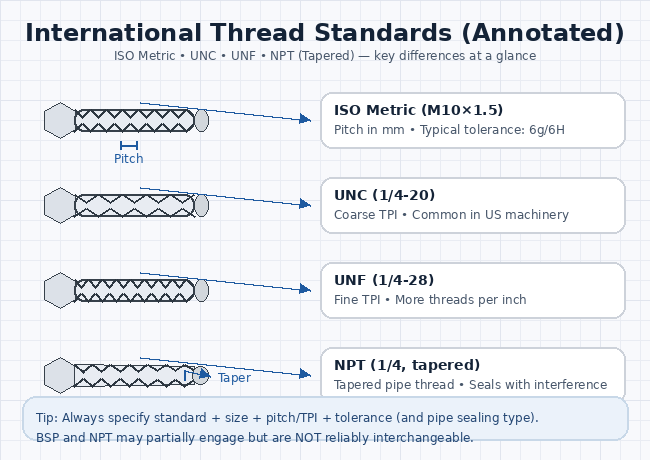
ISO metric threads are identified by “M” followed by the nominal diameter in millimeters, such as M8 or M10. When needed, the pitch is included after an “x,” for example M10 x 1.5. If pitch is not stated (M10), it typically implies the coarse (standard) pitch for that diameter.
The most common purchasing mistake is specifying the diameter but not the pitch. M10 x 1.5 and M10 x 1.0 look similar but will not mate. That is why engineers often search “metric thread pitch chart” or “M10 pitch.” For critical assemblies, ISO thread tolerance also matters. You may see tolerance classes such as 6g for external threads (bolts/screws) and 6H for internal threads (nuts/tapped holes). These classes influence fit, assembly torque consistency, and wear behavior.
Unified Threads (UNC/UNF): Common in US-Standard Equipment
Unified threads use inch-based diameters and threads-per-inch (TPI). A common example is 1/4-20 UNC, where 20 indicates 20 threads per inch. Two major series are widely used:
- UNC (Unified National Coarse): Coarse pitch, generally more tolerant of dirt and damage, often used in general machinery.
- UNF (Unified National Fine): Fine pitch, often selected for higher thread engagement in limited length, better adjustment, and sometimes improved resistance to loosening.
Because Unified threads do not convert directly to metric “by eye,” buyers frequently search “UNC vs UNF” and “UNC thread chart.” The best practice is to specify the exact callout (diameter + TPI + series) and verify with gauges when replacing components in older equipment.
International Thread Standards in Piping: BSP vs NPT
Pipe threads are where mistakes become expensive. A connection may screw together partially and still fail sealing under pressure. The two most common families are:
- BSP (British Standard Pipe): Often found in Europe and many international systems. BSPP is parallel (often marked “G”), and BSPT is tapered (often marked “R”).
- NPT (National Pipe Taper): Widely used in the United States. NPT is tapered and seals through thread interference (often with sealant).
The key issue: BSP and NPT have different thread forms and angles. Even when the size looks similar, they are not reliably interchangeable. This is why “BSP vs NPT difference” is a high-volume search term for maintenance teams. If you work with fittings, valves, hydraulic blocks, or instrumentation, always confirm the exact pipe thread standard and whether the system seals on the thread or on a separate sealing surface.
How to Identify an Unknown Thread in the Field
If you are repairing equipment or verifying incoming parts, use a consistent identification method:
- Step 1: Measure major diameter with calipers (mm and inches if unsure).
- Step 2: Measure pitch using a thread pitch gauge (metric pitch vs TPI).
- Step 3: Determine if the thread is tapered (pipe threads) or parallel (many fastening threads and BSPP).
- Step 4: Confirm tolerance/fit for critical applications (go/no-go gauges).
- Step 5: Consider surface treatment and plating, which can affect thread fit and gauge results.
These steps align with common Google searches such as “how to measure thread pitch” and “how to tell NPT from BSP.”
How Coatings and Manufacturing Tolerances Affect Compatibility
Thread compatibility is not only about the standard name. Coatings and plating thickness can change fit—especially for hot-dip galvanized (HDG) fasteners or thick protective coatings on bolts and nuts. A nut that fits a bare bolt may bind after coating unless the tolerance class is selected appropriately or the internal thread is adjusted for the coating system.
For high-strength fasteners, also consider process requirements related to hydrogen embrittlement when electroplating is involved. While this topic is separate from thread standards, it directly affects how you specify finishes alongside thread requirements in international procurement.
How to Specify Threads Correctly on Purchase Orders
To avoid mismatches, your specification should include:
- Thread standard and designation (M, UNC/UNF, BSPP/BSPT, NPT)
- Size and pitch (e.g., M12 x 1.75 or 3/8-16 UNC)
- Tolerance class or fit requirement (e.g., 6g/6H for ISO metric)
- Fastener type and standard (screw/bolt/stud/nut and ISO/DIN/ASME reference if relevant)
- Material and mechanical property class
- Surface treatment/coating and corrosion performance requirement
Clear documentation is the fastest way to reduce line stoppages caused by “almost matching” threads.
Working With a Supplier Who Understands Global Thread Standards
International sourcing often requires cross-referencing standards, confirming thread geometry, and ensuring consistent inspection methods. At IIIBEAR, we support customers with fastener selection and documentation that aligns with international thread standards—helping you avoid assembly issues, reduce returns, and keep maintenance cycles predictable.
Conclusion
International thread standards include ISO metric (M), Unified (UNC/UNF), and pipe thread systems such as BSP and NPT. The safest approach is to specify the full thread callout—standard, size, pitch, and tolerance—then verify with proper gauges when the application is critical. With the right identification method and clear purchase specifications, global fastener compatibility becomes straightforward and repeatable.