Plastic Fasteners in PEEK, PA66 GF30, PPS and PVDF | IIIBEAR
High-Performance Plastic Fasteners Using PEEK, PA66 GF30, PPS and PVDF Materials
Plastic fasteners (also called polymer or non-metallic fasteners) are widely used when corrosion resistance, electrical insulation, lightweight design, and chemical compatibility are more important than maximum mechanical strength. Compared with metal fasteners, plastic fasteners can reduce weight, avoid galvanic corrosion, and improve safety in electrically sensitive assemblies.
This article focuses on four high-demand engineering materials used for plastic fasteners: PEEK, PA66 + 30% Glass Fiber (PA66 GF30), PPS, and PVDF. You will find each material’s key advantages, limitations, and typical applications to help you select the right plastic fastener for your project.
1) PEEK Fasteners (Polyether Ether Ketone)
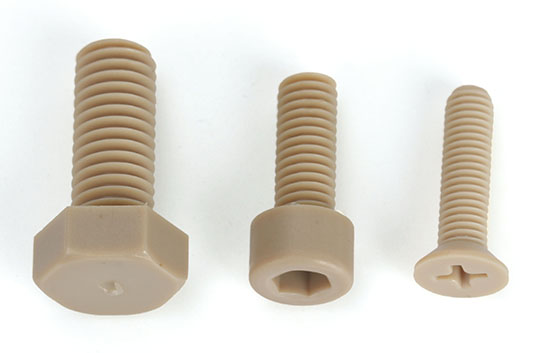
PEEK is one of the highest-performance engineering thermoplastics used for plastic fasteners. It is chosen for demanding environments where high temperature resistance, mechanical strength, and long-term stability are required.
Main Advantages
- High temperature capability: suitable for continuous use in high-heat environments.
- Excellent mechanical strength: stronger than most engineering plastics and maintains properties over time.
- Outstanding chemical resistance: performs well against many fuels, oils, and industrial chemicals.
- Low creep and good dimensional stability: helps maintain clamp load in critical assemblies.
- Good wear resistance: suitable for dynamic or friction-prone components.
Typical Applications
- Aerospace and high-end industrial equipment
- Semiconductor and cleanroom tooling (low contamination preference)
- Automotive under-hood components and thermal zones
- Medical and laboratory equipment (application-dependent compliance)
Best Use Cases
Choose PEEK fasteners when you need a premium polymer solution for high temperature, high reliability, or long service life requirements.
2) PA66 + 30% GF Fasteners (Nylon 66 Glass-Filled)
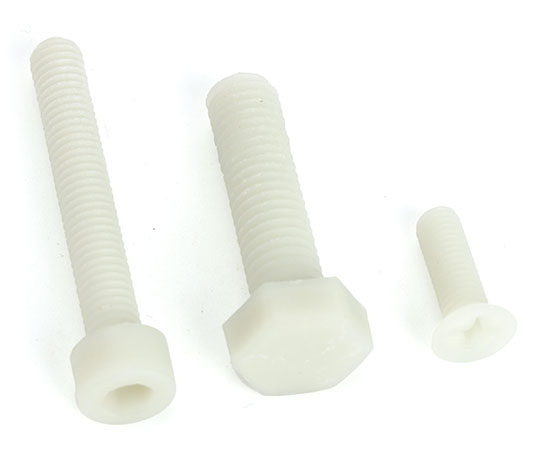
PA66 GF30 (Nylon 66 reinforced with 30% glass fiber) is a cost-effective engineering plastic that balances strength, stiffness, and manufacturability. The glass fiber reinforcement significantly improves mechanical performance compared with unfilled PA66.
Main Advantages
- Higher strength and stiffness: glass fiber reinforcement improves load-bearing capability.
- Good fatigue performance: suitable for repeated load conditions in many assemblies.
- Excellent cost-performance ratio: widely used for industrial and automotive components.
- Lightweight: reduces overall assembly weight versus metal fasteners.
Important Considerations
- Moisture absorption: nylon materials can absorb moisture, potentially affecting dimensions and strength.
- Temperature limits: suitable for moderate heat; for sustained high temperature, consider PPS or PEEK.
Typical Applications
- Automotive interior and exterior assemblies
- Electrical housings and general-purpose industrial fastening
- Appliances, fixtures, and light mechanical structures
3) PPS Fasteners (Polyphenylene Sulfide)
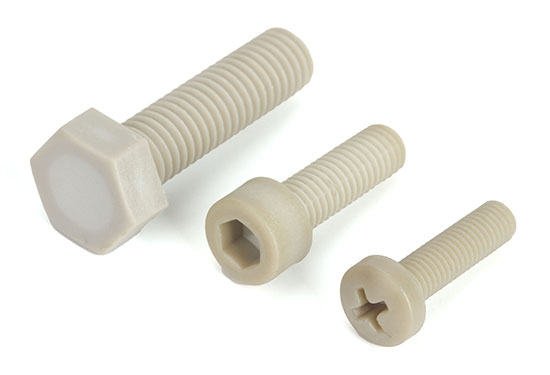
PPS is known for its excellent thermal stability, chemical resistance, and low moisture absorption. It is commonly used when nylon’s moisture sensitivity is a concern, or when higher temperature resistance is required.
Main Advantages
- High heat resistance: suitable for elevated temperature assemblies.
- Excellent chemical resistance: performs well against many solvents, fuels, and industrial chemicals.
- Very low moisture absorption: supports stable dimensions and consistent performance.
- Good flame resistance: often selected for electrical and electronics environments (grade-dependent).
Typical Applications
- Electronics and electrical components (connectors, housings, insulating structures)
- Automotive under-hood parts exposed to heat and chemicals
- Industrial equipment where dimensional stability is critical
Best Use Cases
Choose PPS fasteners when you need a stable, heat-resistant polymer with strong chemical resistance and low moisture uptake.
4) PVDF Fasteners (Polyvinylidene Fluoride)
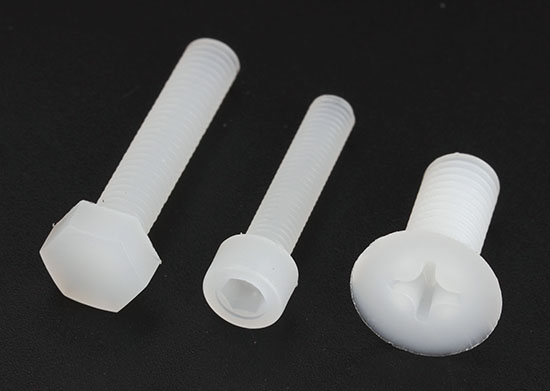
PVDF is a fluoropolymer valued for excellent chemical resistance, weathering performance, and purity characteristics. It is often chosen for chemical processing, water treatment, and outdoor applications where corrosion resistance and durability matter.
Main Advantages
- Excellent chemical resistance: ideal for acids, bases, and many aggressive chemicals (application-dependent).
- Strong weather and UV resistance: suitable for outdoor and long-term exposure environments.
- Good hydrolysis resistance: performs well in water-related applications.
- Non-corrosive solution: eliminates rust and reduces contamination risk in fluid systems.
Typical Applications
- Chemical processing equipment
- Water treatment and fluid handling systems
- Outdoor installations exposed to UV and harsh environments
- Laboratory and clean utility systems
How to Select the Right Plastic Fastener Material
- High temperature + high reliability: consider PEEK first.
- Cost-effective structural fastening: choose PA66 GF30 for strength and value.
- Heat + chemical exposure with dimensional stability: PPS is a strong choice.
- Chemical processing + outdoor durability: PVDF performs well in corrosive and UV environments.
For best results, always confirm the service temperature, chemical media, load requirements, and installation method (torque, clamp load, reuse cycle) before finalizing your material selection.
Plastic Fasteners from IIIBEAR
IIIBEAR supplies plastic fasteners and fastening solutions for industrial customers worldwide. We support material options including PEEK, PA66 GF30, PPS, and PVDF, with multiple product forms such as bolt, screws, nuts and washers.
If you share your application details (temperature range, chemical environment, and load requirements), our team can recommend the most suitable material and fastener design.

Related products: Plastic Fasteners

